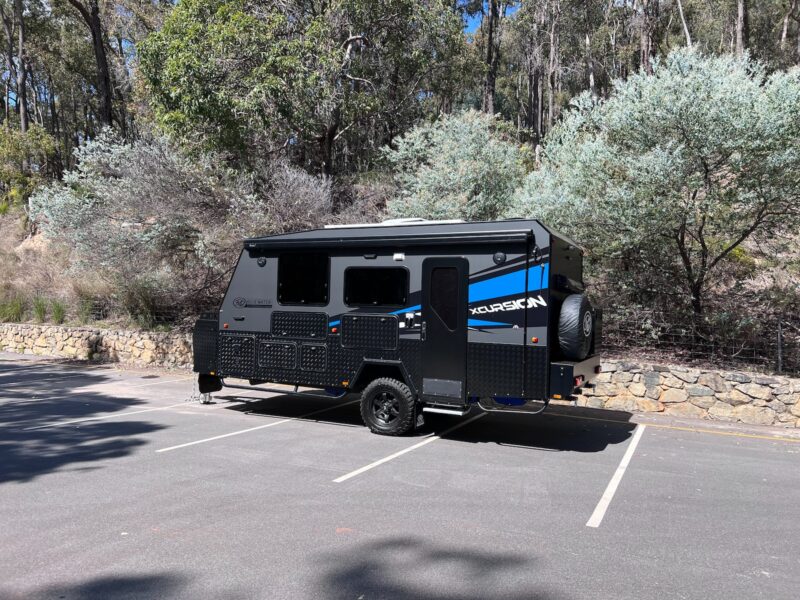


Search “best offroad hybrid caravan” and you get a wall of brands all claiming the same thing. This guide cuts through it: what actually makes a hybrid off-road capable, how to match one to the trip you’re planning, and where the Bluewater range lands when you put the specs side by side.
A hybrid sits between a camper trailer and a full caravan. You get the hard walls, fixed bed and internal kitchen of a caravan on the lighter, higher off-road chassis of a camper trailer. It goes where a full van can’t, sets up in minutes and tows easier.
The same rig gets sold under three names. One buyer searches “hybrid camper,” another “hybrid camper trailer,” another “hybrid caravan” – all describing the same vehicle. The name changes with who’s typing; the product doesn’t. So if you’ve been weighing up “hybrid campers” against hybrid caravans, you’ve been comparing the same category the whole time. Bluewater’s full range covers both labels.
Plenty of vans wear checker-plate and mud tyres without the bones to back it up. Here’s what to actually check.
The right van depends on where you’re pointing it.
Bluewater handles all custom fit-outs in-house at their Kelmscott, WA workshop, testing setups across the same outback, coast and ranges you’ll be towing through. Two models show the range.
The Xpedition Plus is a 16ft off-road pop-top for couples and families. It features a Tare of 2,480kg, an ATM of 3,000kg, and a 220kg ball weight. It runs a 608Ah lithium system that is upgradeable to 912Ah, paired with 600W of solar, a 2,000W inverter and 200L of fresh water. A full-width sitting area folds into a second double bed to sleep two or four people, serviced by two plumbed kitchens inside and out.
The Xcursion is a 16ft couples’ van sharing the same 2,480kg tare and 3,000kg ATM, built around living comfort. It includes a 96L upright fridge, an internal ensuite, and a washing machine. It utilizes the same 608Ah-to-912Ah lithium capacity, 600W solar setup and 200L of fresh water, plus an 80L grey tank. Both models sit on the galvanised chassis, adjustable independent suspension, Lovells shocks and DO35 hitch described above.
Yes. Hybrid camper, hybrid camper trailer and hybrid caravan all describe the same vehicle. The name changes with who’s searching; the product doesn’t.
Yes, within limits. At 3,000kg ATM, these need a 4WD rated to tow 3,000kg or more, with the towball rating and GCM to match – a 200/300 Series LandCruiser, Ranger, Everest or similar. Check your vehicle’s plate against the van’s ATM and ball weight (220–250kg) before you buy, not after.
That’s exactly what the galvanised chassis, independent coil suspension and gas shocks are for. Keep your speed sensible, air down, and a well-built hybrid handles corrugations far better than a full caravan ever will.
Straightforward: wash the underbody after dusty or salty trips, check wheel bearings and suspension bolts before big runs, service the brakes, and keep the lithium system topped up. Bluewater backs the chassis and drawbar with a lifetime warranty and services what it builds from the same Kelmscott yard.
A genuine off-road hybrid is defined by what you can’t see in a photo: the chassis, the suspension, the clearance, and the water and power to stay out. Judge on specs, match the van to your trip, and the shortlist gets short fast.
Ready to check out our campers in person? Book a demo with our team to explore your options and get all your questions answered.
This site is protected by reCAPTCHA and the Google Privacy Policy and Terms of Service apply.
This site is protected by reCAPTCHA and the Google Privacy Policy and Terms of Service apply.
